


Wolterton Hall: Georgian Palladian House in Norfolk
In the heart of North Norfolk stands an exquisite Palladian masterpiece, a home woven deeply into Britain’s history. Welcome to Wolterton.
Once one of England’s most powerful aristocratic families, the Walpoles established their influence in North Norfolk from the 14th century and continue to play a significant role in the region today, nurturing local culture and community.
Once a bastion of aristocratic power, the Walpoles have left an indelible mark on English history for centuries. Hidden amidst Norfolk’s gently rolling farmland, Wolterton Hall is a delightful stately home, harmonising architectural elegance with breathtaking views. Here, the grand stage of history meets the rhythms of everyday family life.
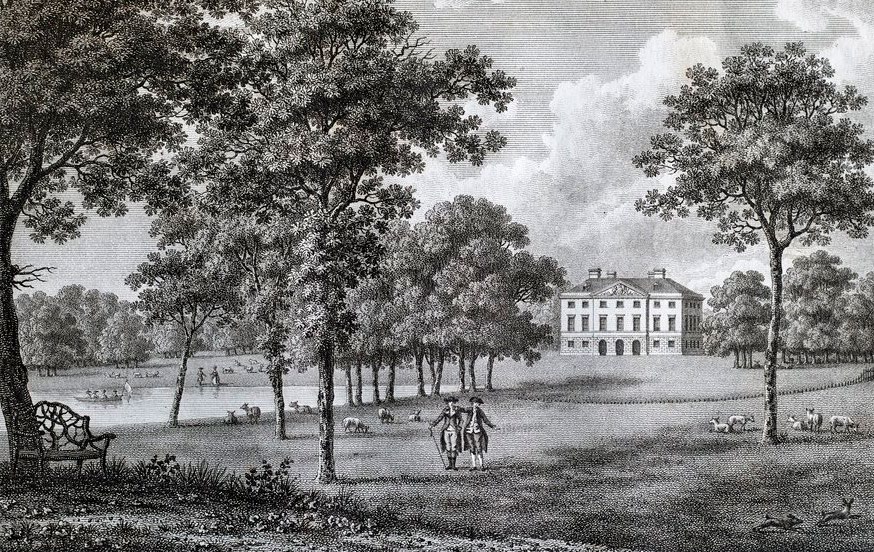
The south gardens and lake, 1st November 1783.

The Hall was commissioned by Horatio Walpole, affectionately dubbed ‘Old Horace’. As the younger brother of Sir Robert Walpole, Britain’s first Prime Minister, Horatio was no stranger to political intrigue especially as Ambassador to France. In 1722, he decided to carve his own legacy.
He purchased a medieval manor twenty miles from his brother’s home, Houghton Hall, and embarked on ambitious renovations.
However, disaster struck: in 1724, Old Wolterton went up in flames. Undeterred, Horatio enlisted the talented architect Thomas Ripley, fresh from his work at Houghton Hall, to bring his vision to life. Together, they crafted a magnificent Palladian masterpiece that rose triumphantly, a phoenix from the ashes, after over 15 years’ work.
Wolterton became one of Norfolk’s renowned Whig ‘Power Houses’, alongside Houghton, Holkham and Raynham. As the decades passed, the estate evolved.
By the early 19th century, the Hall underwent a fashionable transformation. The original Palladian steps leading to the Marble Hall were replaced with a porte cochère, designed for the grand arrival of carriages.
In 1828, George Repton, son of the illustrious landscape designer Humphry Repton, was commissioned to add an East Wing and embellish the south façade with grand Portland stone steps and a dramatic balcony. Rumour had it that a West Wing was planned but never built — an ambitious dream thwarted by the financial realities of landed gentry.
The family portrait by Jacopo Amigoni. At nine feet wide it was too large to fit into any other Walpole house, so was cut into seven pieces when the family moved temporarily. Now expertly restored, it’s impossible to see the joins. It shows Horatio and his wife Mary Magdalen, with their eight children. Clearly not all so close in age, there is creative licence in this idealised family tableau. In a touching detail, the cherubs represent stillborn infants.
The portrait of King George I, given by his Majesty to Horatio, along with other portraits of the royal family, still hangs in the state dining room in Wolterton Hall.
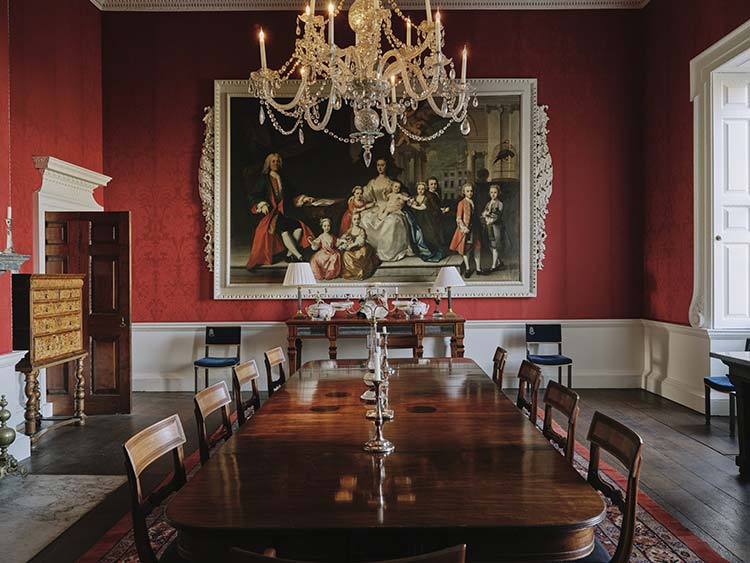
The State Dining Room with the carefully repaired Amigoni Family Portrait.

The Venetian Room, with golden silk fabric walls.
Admiral Lord Nelson, godson of the second Baron Horatio Walpole and one of Britain’s greatest military heroes, owned the sword of his naval predecessor, Galfridus Walpole the brother of Robert and the first Baron Horatio. Today guests at Wolterton can stay in Nelson’s room where the hero is thought to have slept, immersing themselves in the private world of a man who shaped history.
Wolterton is one of the four Whig ‘Power Houses’ of North Norfolk, alongside Houghton Hall, Holkham Hall, built by the Coke family, and East Raynham, home to the Townshend family.

The Saloon Tapestries
Though not particularly fond of country life, Horace Walpole — Horatio’s famously acerbic nephew — was enchanted by Wolterton and its picturesque ‘all wood and water’ setting. His affection for the estate, however, did not extend to his uncle, whom he depicted as a tiresome old buffer. By contrast, Lady Nancy Walpole, writing two centuries later in the mid-20th century, described Horatio as ‘kind, honest, and forthright’, painting a more amiable portrait of Wolterton’s founder.
Beyond serving as a family residence, Wolterton was constructed with discretion in mind. A sequence of imposing double doors, still in place today, were designed to muffle overheard conversations — a thoughtful gift from Queen Caroline to Horatio. As Britain’s ambassador to France, he had skilfully forged a strong alliance with Cardinal Fleury, Louis XIV’s foreign minister. In gratitude for Horatio’s role in brokering peace — the very foundation of Britain’s prosperity — Fleury gifted the exquisite tapestries still displayed in the Saloon. Look closely; the elaborate needlework reveals cheeky details inviting the amused eye to linger. Oui, oui!
Fast forward to the mid-20th century, and Wolterton had settled into the comforting rhythms of country life. Lady Nancy Walpole, who penned detailed accounts of her life at Wolterton, described walking dogs, milking cows, collecting eggs, and enjoying picnics by the serene lake.
On her first visit, she felt her nerves ease, enchanted by the estate’s tranquility as she gazed at the view from the Library, where she was welcomed for tea to meet to her future mother in law.
In 1951, Wolterton welcomed Queen Mary for tea, with the royal inspecting the State Rooms before going down to the Library and through the windows onto the lawns where she showed young Phillida Walpole how to kick a ball which became treasured in the toy cupboard!
The following year, calamity struck once more. As the family settled down for lunch in 1952, the ever-dutiful butler, Cruickshank, alerted them to a fire. Eight fire brigades battled the blaze, and over 100 locals rushed to save priceless portraits and furniture from the flames. Yet, Wolterton proved resilient; soon, the family was hosting Queen Elizabeth, the Queen Mother, in the cosy cellar Servants’ Quarters, while repairs were underway.
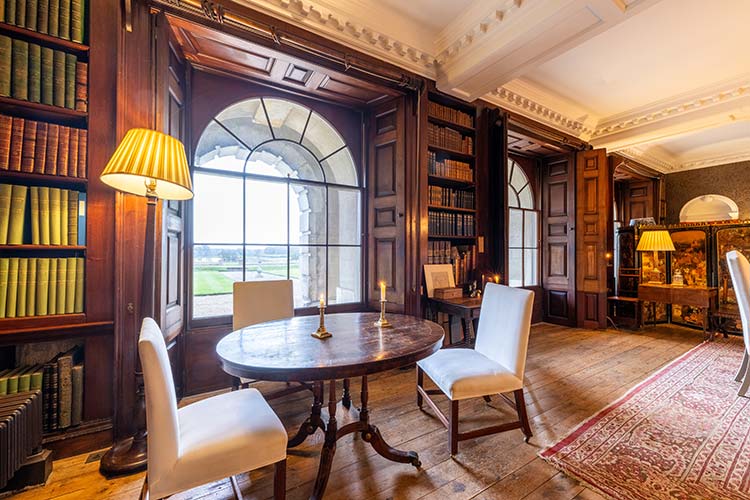
The Library Windows, through which Queen Mary stepped to walk on the lawns.
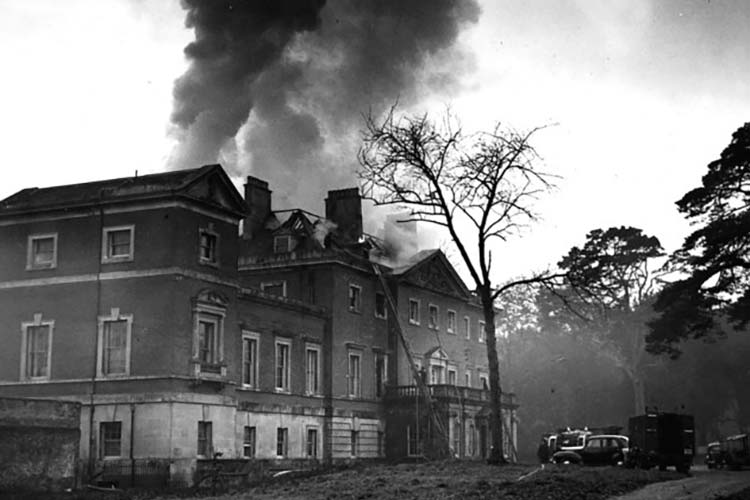
Fire in 1952. During restorations, a section of blackened wood was deliberately left exposed on a door lintel, subtly marking Wolterton’s resilience.
In 2016, award-winning restorers Peter Sheppard and Keith Day took on the mantle of reviving Wolterton’s grandeur. Their meticulous restoration brought a contemporary twist to the estate’s rich legacy. Wolterton won a Georgian Group Architectural Award in 2022 and was joint winner of a Historic Houses restoration award in 2023.
In 2023, Wolterton embarked on a vibrant new chapter with the arrival of the Ellis family, whose Norfolk roots reach back over 300 years in the crafts of silversmithing and tailoring.
Like their late uncle, Ted Ellis, a beloved naturalist and steadfast champion of Norfolk’s wildlife, the family holds a deep appreciation for the region’s landscape and legacy. With an eye to Wolterton’s storied past and a heart for its future, the Ellis family brings fresh energy and vision to this remarkable estate.
And so, Wolterton Hall stands resplendent, its grandeur slightly singed yet undeniably impressive. Far more than a monument to history, Wolterton is a living, breathing home, rich with memories and open to new stories waiting to unfold — a testament to the enduring power of family, resilience, and the inspired art of reinvention.

We will always honour your privacy.
